Yantra vs Mantra: Understanding the Difference Between Sacred Geometry and Sacred Sound

In Indian spiritual traditions, Yantras and Mantras are often used as tools for devotion, meditation and contemplation. Although their names are similar and some practices combine them, they represent different approaches: a Yantra is primarily a visual geometric form, while a Mantra is a sacred sound, syllable, word or phrase repeated or recited as part of a spiritual practice.
Understanding the difference between Yantra and Mantra can help you explore their traditional meanings and how they may be used in meditation, worship and personal reflection.
At Maitri Foundation, our upcoming Nine-Planet Yantra Consultation will introduce participants to the traditional symbolism of planetary Yantras and their place in spiritual practice.
What Is a Yantra?
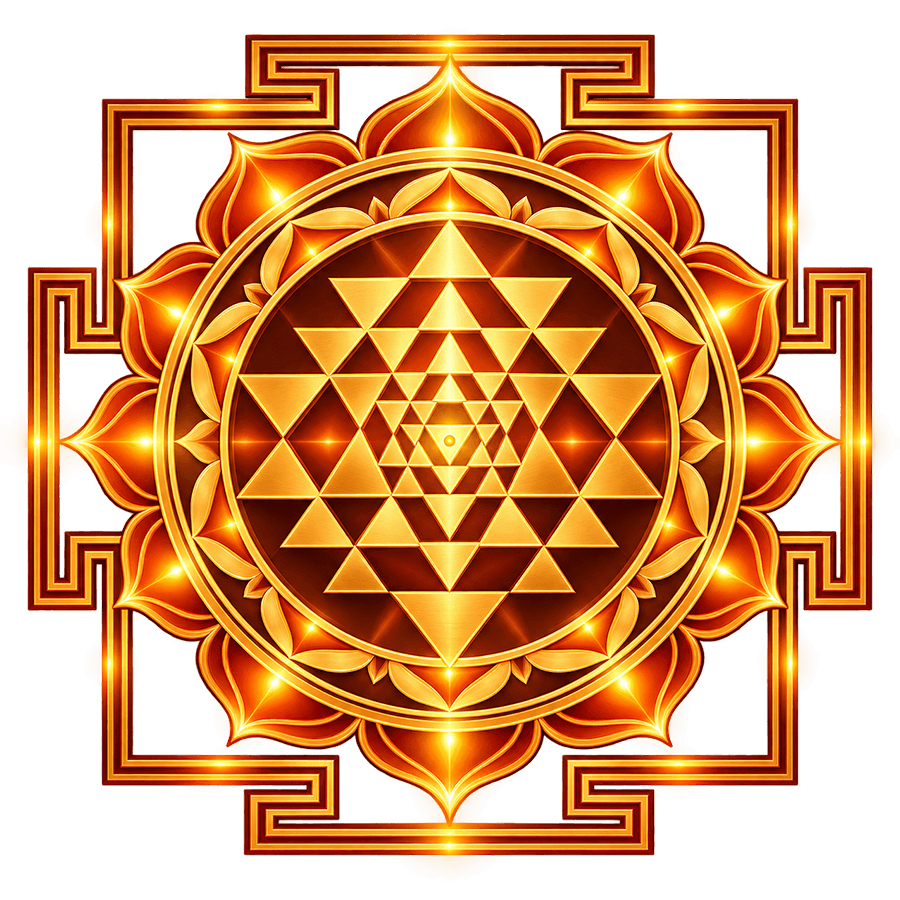
A Yantra is a geometric design used in several Indian spiritual and Tantric traditions. Depending on the tradition, it may include shapes such as triangles, circles, lotus petals and squares, arranged in a specific pattern.
Yantras are associated in some traditions with deities, spiritual concepts or planetary influences. Practitioners may use them as visual focal points during meditation, worship or contemplation.
The design is not simply decorative within these traditions. Its form and arrangement may carry symbolic meaning, interpreted according to the particular spiritual practice or lineage.
Yantras can vary considerably. Their meaning, use and ritual requirements depend on the specific Yantra and the tradition in which it is used.
What Is a Mantra?
A Mantra is a sound, syllable, word or phrase used in a spiritual or contemplative practice. Mantras may be recited aloud, chanted, whispered or repeated silently, depending on the tradition and method.
In Indian spiritual traditions, Mantras may be associated with a deity, a spiritual intention, a ritual or a meditation practice. Some are short seed syllables, while others are longer verses or invocations.
For practitioners, repeating a Mantra can provide a structured focus for attention, devotion and reflection. The meaning and appropriate method of recitation depend on the specific Mantra and its tradition.
Yantra vs Mantra: What Is the Difference?
The simplest distinction is that a Yantra is primarily visual, while a Mantra is primarily auditory or verbal.
| Aspect | Yantra | Mantra |
|---|---|---|
| Main form | Geometric design or sacred diagram | Sacred sound, syllable, word or phrase |
| Main way of engaging | Looking at, contemplating or ritually using a design | Reciting, chanting, listening to or mentally repeating a sound or phrase |
| Role in practice | Provides a visual focus and carries traditional symbolism | Provides an auditory or mental focus and carries traditional meaning |
| Common contexts | Meditation, worship, contemplation and specific rituals | Meditation, chanting, worship and specific rituals |
| Variation | Designs and meanings differ by tradition | Sounds, meanings and methods differ by tradition |
These are broad distinctions. Specific practices can be more complex, and the meaning of either depends on the tradition and context.
How Are Yantras and Mantras Connected?
Some Indian spiritual traditions use Yantras and Mantras together. In such practices, a Yantra may serve as the visual focus while a corresponding Mantra is recited as part of worship, meditation or ritual.
The relationship is not universal: not every Yantra is used with the same Mantra, and not every Mantra requires a Yantra. The appropriate pairing and method depend on the particular tradition, deity, practice or guidance followed.
If you are learning a specific practice, it is best to ask a knowledgeable practitioner about its meaning, pronunciation, preparation and customary method rather than assuming that any Mantra can be paired with any geometric design.
What Is a Planetary Yantra?
In Indian astrological traditions, the Navagraha refers to nine planetary influences: Surya (Sun), Chandra (Moon), Mangala (Mars), Budha (Mercury), Brihaspati or Guru (Jupiter), Shukra (Venus), Shani (Saturn), Rahu and Ketu.
Some traditions associate particular Yantras and Mantras with these influences. They may be used in devotional or ritual practices intended to honour or contemplate the traditional significance of the Navagraha.
The exact designs, Mantras and rituals vary. Planetary associations are part of traditional and astrological belief systems and should not be presented as scientifically established mechanisms or guaranteed ways to change life events.
Maitri Foundation plans to introduce a Nine-Planet Yantra Consultation. Enquiries can help clarify which traditions and practices the consultation will cover, whether Mantra guidance is included, and what participants can expect.
Can Yantras and Mantras Be Used in Meditation?
Depending on the practice, either a Yantra or a Mantra may provide a focus for meditation.
Yantra-based contemplation
A practitioner may observe a geometric design and gently return attention to it when the mind wanders. In a traditional setting, the design may also be part of a devotional or ritual practice.
Mantra-based meditation
A practitioner may repeat a sound or phrase aloud or silently, directing attention to the repetition and, where relevant, its meaning.
Combining both
Some traditions combine visual contemplation with Mantra recitation. If you wish to learn a specific practice, follow reliable guidance from someone knowledgeable in that tradition.
These approaches may be meaningful as personal spiritual practices. Individual experiences vary, and they should not be described as guaranteed treatments for medical conditions or as proven methods for changing planetary influences.
What About the Nine Designs in Sacred Geometry?
The book reference shared with Maitri Foundation describes nine designs associated with qualities such as Radiance, Nourishment, Passion, Intellect, Expansion, Bliss, Organization, Uniqueness and Spirituality. It explores working with geometric forms, colour and creative reflection.
These nine designs should not automatically be equated with the nine planetary Yantras of the Navagraha. They are different concepts unless a specific tradition or source establishes a connection.
The book’s creative approach can be discussed as a way of exploring symbolism and mindful attention, while planetary Yantra consultation can focus on the traditional associations relevant to the Navagraha.
How to Begin Exploring Yantras and Mantras
If you are new to these practices, start by learning their context rather than treating them as interchangeable techniques.
- Learn the background. Understand the tradition associated with the Yantra or Mantra you are exploring.
- Clarify the purpose. Ask whether the practice is intended for worship, meditation, contemplation or a specific ritual.
- Seek appropriate guidance. Some practices may have traditional instructions or prerequisites.
- Approach the practice respectfully. Avoid assuming that all Yantras, Mantras or lineages follow the same rules.
- Keep expectations realistic. Treat spiritual meanings as part of their relevant tradition and do not rely on them as a substitute for professional medical, mental-health or financial advice.
Explore Yantra Consultation at Maitri Foundation
Maitri Foundation plans to introduce Nine-Planet Yantra Consultation as a spiritual wellness offering. The service is intended to help interested participants learn about the traditional symbolism of planetary Yantras and their place in spiritual practice.
If you would like to understand the consultation format, the Yantras covered, or whether the service includes Mantra guidance, contact Maitri Foundation for details.
Enquire About Yantra Consultation
Frequently Asked Questions
Is a Yantra the same as a Mantra?
No. A Yantra is primarily a visual geometric design, while a Mantra is a sound, syllable, word or phrase used in spiritual practice. Some traditions use them together, but they are not the same thing.
Which is more powerful, Yantra or Mantra?
There is no universal or scientifically established ranking of one as more powerful than the other. Their significance depends on the tradition, the specific practice and the beliefs of the practitioner.
Can I use a Yantra without chanting a Mantra?
Practices vary. Some use a Yantra for visual contemplation or worship without accompanying recitation, while others include a specific Mantra. Follow guidance appropriate to the particular practice.
Can any Mantra be used with any Yantra?
No general rule supports pairing any Mantra with any Yantra. In traditions that combine them, the association may be specific to a deity, practice or lineage. Seek knowledgeable guidance.
Are Navagraha Yantras connected with the nine planets?
Some Indian astrological and spiritual traditions associate particular Yantras and Mantras with the Navagraha. The exact designs and practices differ across traditions, and their planetary effects are traditional beliefs rather than established scientific facts.
Are the nine designs in The Nine Designs the same as the nine planetary Yantras?
The supplied book reference describes nine designs associated with personal qualities. That alone does not establish that they are the same as the nine planetary Yantras. The two systems should be kept distinct unless a reliable source confirms a specific connection.
Can Yantra or Mantra practice treat health conditions?
These are spiritual practices, not substitutes for medical diagnosis or treatment. Consult an appropriately qualified healthcare professional for health concerns.
Conclusion
Yantra and Mantra offer two distinct forms of engagement within Indian spiritual traditions: one visual and geometric, the other auditory or verbal. Some practices bring them together, while others use them separately. Learning their context and traditional meaning is the best starting point for exploring either practice respectfully.
To learn more about Maitri Foundation’s planned Nine-Planet Yantra Consultation, contact the team to ask about the service and the practices it includes.
Disclaimer: This article is for general educational purposes. It describes traditional spiritual concepts and does not establish scientific claims about planetary effects, healing frequencies or guaranteed outcomes. Yantra and Mantra practices are not substitutes for professional medical, psychological or other appropriate advice.